

Family goodness for over fifty years
It was 1968 when, in Prata di Pordenone, Lino Follador and his wife Angela opened a small provincial bakery. Their production was intended for the local market, with carefully selected raw materials from trusted suppliers. The two owners cultivated a family relationship with customers, even during home deliveries. This is the atmosphere in which Antonio, their son, grew up, until 1999 when he began managing the historic family shop independently.
In 2007, Antonio Follador introduced café and deli services to La Bottega, the first shop in Prata di Pordenone. In 2015, he opened Il Posto in Pordenone, a second bistro; while two years later an important dream became reality: Lo Spaccio was born, the new 2,000 sq m workshop, which also houses the store.
Here, behind the counter, a large window allows you to watch the brigade at work live, preparing fresh bread, pizza by the slice, filled focaccia, fresh and dry pastries, leavened products and much more.
The secret to Follador's quality remains craftsmanship, traditional know-how.
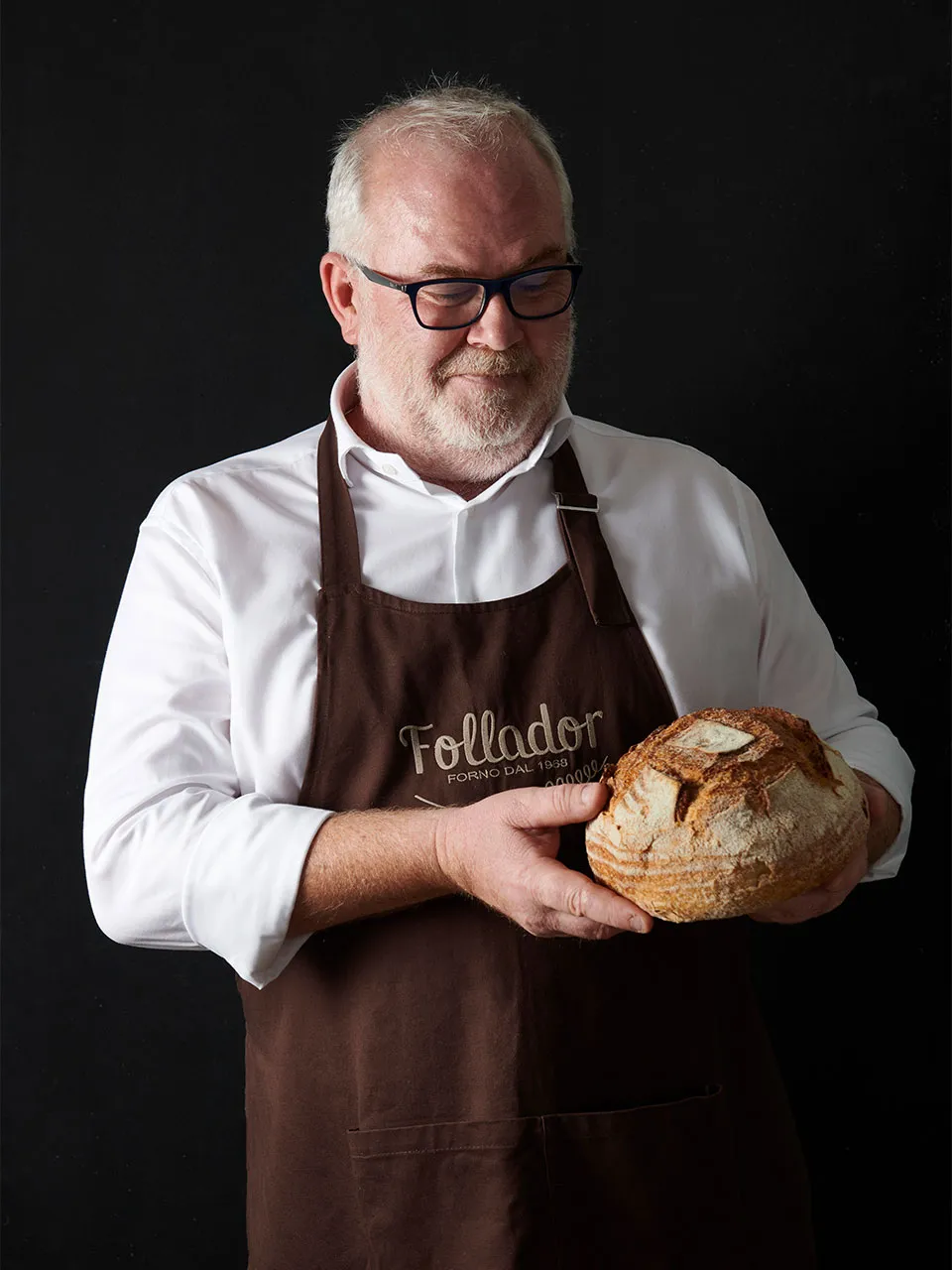
Antonio Follador
Born in 1968, Antonio was born the same year as Forno Follador: he breathed the scent of yeast and flour from childhood, learning the secrets of dough. He began working in the family business in 1989, after completing his studies, dedicating over ten years to training and specialization in baking and pastry-making. 1999 was an important year: Antonio became owner of Forno Follador and joined the Richemont Club Italia, an association that allowed him to travel frequently throughout Europe to deepen his knowledge of the craft through courses, internships, company visits and public meetings.
He learned to seek out the finest raw materials, perfected production techniques and worked every day on small and large innovations.
"If three is the perfect number, Follador today represents its complete synthesis. Three generations, three shops (Il Posto, Lo Spaccio and La Bottega) within a few kilometers and decades of consistent goodness. For nearly thirty years, Antonio Follador has led the business, now supported by a team of young collaborators. A management capable of preserving traditions without giving up research and continuous improvement.
Technique, experience, tradition, evolution, ancient gestures and cutting-edge technology merge with the aim of creating a product that is at once artisanal, sustainable and delicious. A successful endeavor confirmed by unstoppable success and by elements that transcend success: authentic quality of raw materials and their careful processing, first and foremost. Natural leavening, different for each dough, careful selection of raw materials and a counter that makes you want to taste everything (the rest you take home). The filled focaccia (without sauces and various artifices) is a hymn to joy: crispy crust, perfectly honeycomb and melt-in-your-mouth interior, sweetness and acidity that blend in the dough. To be clear, one is not enough. Same for the pizza, always cooked to perfection, from edges to center and topped according to season. The bread is a known story, from loaves to soft breads you can't go wrong. Just as the pastry is now epic history. Try the bombolone for everyone, but don't miss booking a grand leavened product for Easter (our favorite is the Venexiana with apricot) or Christmas, your table will be grateful."
These are the reasons expressed by Gambero Rosso, which awards Forno Follador the Three Breads of the Pane & Panettieri d'Italia 2027 Guide.

Today Antonio Follador is a guarantor member of the Consortium for the Protection of Sourdough Starter, which is committed to protecting, promoting and enhancing baked goods made exclusively with sourdough starter produced in the workshop by artisan leaveners and considered a heritage of humanity.

Today Forno Follador is based in Pordenone, where our stores are located: Il Posto, Lo Spaccio and La Bottega (in Prata di Pordenone). In our workshop, research, training and technological innovation come together, ensuring a virtuous production process in full respect of nature's cycles and work rhythms.
The workshop: a contemporary artisan shop
Every day Antonio Follador works alongside his team to pass on the lessons of his experience and ancient artisan knowledge. In the laboratory, the first secret to learn lies in the magic of sourdough starter fermentation, which introduces biodiversity into baked goods, makes them more digestible, extends their shelf life, and enhances the character of different wheat varieties.
4.0 system, mixers, blast chillers and latest generation ovens, cold chain and continuous technological advancement allow us to combine the natural times of production and processing of raw materials with the times of work, preparation, baking and transport of the finished product.